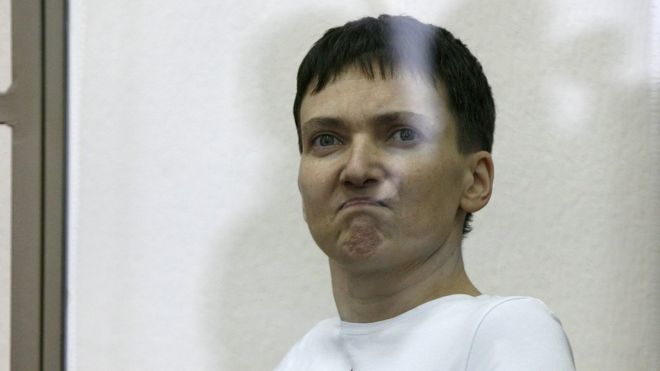
 A Russian judge has begun reading the verdict on Ukrainian pilot Nadia
Savchenko, accused of killing two Russian journalists.
Summing up the prosecutors' case, the judge in the Russian town of
Donetsk said Ms Savchenko had been driven by "political hatred".
It was initially thought the judge had found her guilty, but journalists
say a final verdict has not been delivered.
Prosecutors have called for her to be jailed for 23 years.
They argue that Ms Savchenko directed the artillery fire in which the
two journalists, Igor Kornelyuk and Anton Voloshin, were killed.
Ukraine and some Western countries have condemned the case as a show
trial.
Ms Savchenko's lawyer had argued phone records proved she was captured
by pro-Russian rebels before the attack.
She will be sentenced on Tuesday, after the court hands down its
eventual verdict.
Ukraine resistance symbol in Russia
Caught in the middle of a media war
'A symbol of defiance and hope'
One of her lawyers had said earlier there was "no doubt" that the court
in Donetsk, southern Russia, would sentence her to a "few dozen years".
"A propaganda machine is at work here, absent of justice and freedom,"
said Mark Feigin on Twitter.
Ms Savchenko, who is on hunger strike, is alleged to have directed
mortar fire that killed the two Russian state TV journalists - a claim
she denies.
The incident happened in June 2014, at the height of fighting between
Ukrainian forces and pro-Russian rebels.
The 34-year-old, who is also a member of the Ukrainian parliament, says
she was kidnapped by rebel fighters at least an hour before the attack
and later handed over to the Russian authorities.
But Russian prosecutors say she secretly crossed into Russian territory
herself.
Western politicians have called for her release.
EU foreign policy chief Federica Mogherini has said she should be freed
"immediately and unconditionally" while the US envoy to the UN, Samantha
Power, described the trial as "farcical".
Relations between Russia and Ukraine - along with its Western allies -
have deteriorated since the events of 2014 in Ukraine.
Moscow annexed the Crimean peninsula that March after an unrecognised
referendum on self-determination, and is accused of covertly supporting
the rebels in the bloody conflict which later divided eastern Ukraine.
A Russian judge has begun reading the verdict on Ukrainian pilot Nadia
Savchenko, accused of killing two Russian journalists.
Summing up the prosecutors' case, the judge in the Russian town of
Donetsk said Ms Savchenko had been driven by "political hatred".
It was initially thought the judge had found her guilty, but journalists
say a final verdict has not been delivered.
Prosecutors have called for her to be jailed for 23 years.
They argue that Ms Savchenko directed the artillery fire in which the
two journalists, Igor Kornelyuk and Anton Voloshin, were killed.
Ukraine and some Western countries have condemned the case as a show
trial.
Ms Savchenko's lawyer had argued phone records proved she was captured
by pro-Russian rebels before the attack.
She will be sentenced on Tuesday, after the court hands down its
eventual verdict.
Ukraine resistance symbol in Russia
Caught in the middle of a media war
'A symbol of defiance and hope'
One of her lawyers had said earlier there was "no doubt" that the court
in Donetsk, southern Russia, would sentence her to a "few dozen years".
"A propaganda machine is at work here, absent of justice and freedom,"
said Mark Feigin on Twitter.
Ms Savchenko, who is on hunger strike, is alleged to have directed
mortar fire that killed the two Russian state TV journalists - a claim
she denies.
The incident happened in June 2014, at the height of fighting between
Ukrainian forces and pro-Russian rebels.
The 34-year-old, who is also a member of the Ukrainian parliament, says
she was kidnapped by rebel fighters at least an hour before the attack
and later handed over to the Russian authorities.
But Russian prosecutors say she secretly crossed into Russian territory
herself.
Western politicians have called for her release.
EU foreign policy chief Federica Mogherini has said she should be freed
"immediately and unconditionally" while the US envoy to the UN, Samantha
Power, described the trial as "farcical".
Relations between Russia and Ukraine - along with its Western allies -
have deteriorated since the events of 2014 in Ukraine.
Moscow annexed the Crimean peninsula that March after an unrecognised
referendum on self-determination, and is accused of covertly supporting
the rebels in the bloody conflict which later divided eastern Ukraine.Monday, March 21, 2016
Savchenko trial: Russian court gives verdict on Ukrainian pilot
A Russian judge has begun reading the verdict on Ukrainian pilot Nadia
Savchenko, accused of killing two Russian journalists.
Summing up the prosecutors' case, the judge in the Russian town of
Donetsk said Ms Savchenko had been driven by "political hatred".
It was initially thought the judge had found her guilty, but journalists
say a final verdict has not been delivered.
Prosecutors have called for her to be jailed for 23 years.
They argue that Ms Savchenko directed the artillery fire in which the
two journalists, Igor Kornelyuk and Anton Voloshin, were killed.
Ukraine and some Western countries have condemned the case as a show
trial.
Ms Savchenko's lawyer had argued phone records proved she was captured
by pro-Russian rebels before the attack.
She will be sentenced on Tuesday, after the court hands down its
eventual verdict.
Ukraine resistance symbol in Russia
Caught in the middle of a media war
'A symbol of defiance and hope'
One of her lawyers had said earlier there was "no doubt" that the court
in Donetsk, southern Russia, would sentence her to a "few dozen years".
"A propaganda machine is at work here, absent of justice and freedom,"
said Mark Feigin on Twitter.
Ms Savchenko, who is on hunger strike, is alleged to have directed
mortar fire that killed the two Russian state TV journalists - a claim
she denies.
The incident happened in June 2014, at the height of fighting between
Ukrainian forces and pro-Russian rebels.
The 34-year-old, who is also a member of the Ukrainian parliament, says
she was kidnapped by rebel fighters at least an hour before the attack
and later handed over to the Russian authorities.
But Russian prosecutors say she secretly crossed into Russian territory
herself.
Western politicians have called for her release.
EU foreign policy chief Federica Mogherini has said she should be freed
"immediately and unconditionally" while the US envoy to the UN, Samantha
Power, described the trial as "farcical".
Relations between Russia and Ukraine - along with its Western allies -
have deteriorated since the events of 2014 in Ukraine.
Moscow annexed the Crimean peninsula that March after an unrecognised
referendum on self-determination, and is accused of covertly supporting
the rebels in the bloody conflict which later divided eastern Ukraine.
Subscribe to:
Post Comments (Atom)
No comments:
Post a Comment