 Is there such an unbelievable marvel as security so great it's a risk to society?
 That is the master plan close by as Apple keeps on battling a request to open a terrorist's iPhone.
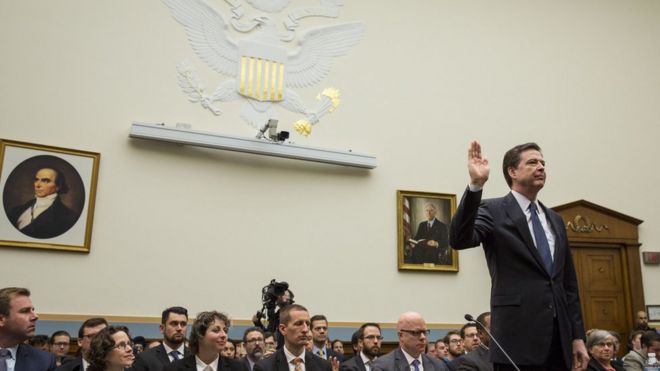
That battle advanced toward Capitol Hill on Tuesday for a hearing before the House Judiciary Committee, the administration body that covers matters identifying with how peace is implemented in the US.
Through the span of four wandering hours, agents jumped carelessly into the complexities of the case FBI executive James Comey said is the most troublesome issue he has ever needed to manage.
He told the board of trustees that his association was truly worried by the development of what law implementation depict as "warrant-confirmation spaces" - the term given for techniques for correspondence or capacity that, even with the right authorization from the court, can't be gotten to. Not by police and not by innovation organizations.
Picture copyright Getty Images
His request that Apple helps his office in debilitating the iPhone's security was met with this from California Congresswoman Zoe Lofgren.
"The option [to solid encryption] is a world where nothing is private.
"When you have gaps in encryption, the principle is not an issue of if, but rather when those gaps will be misused and all that you believed was ensured will be uncovered."
Physical interruption
Apple was spoken to in this hearing by its lead counsel, Bruce Sewell.
Beside client letters, and a to some degree stage-oversaw meeting with ABC, it's the first run through the registering monster has been put under investigation over its refusal to conform to the FBI request.
Mr Sewell put in a solid execution on account of, the affirmation of cryptology master Prof Susan Landau - whose significant data I'll talk about later.
Mr Sewell persevered through wild trades with South Carolina Congressman Trey Gowdy, who was furious at what he esteemed a resistance in this questionable case.
How is it conceivable, the Congressman offered, to live in our current reality where the FBI has the power to stick a finger up somebody's back looking for medications, yet not the ability to take a gander at the bolted iPhone of that same suspect?
There's no basic response to that, obviously, however Apple may challenge that law authorization's capacity to do such physically meddlesome activities doesn't expand the overall population's danger of introduction to a wild finger or two.
'No'
In any case, coarse examination aside, Congressman Gowdy's warmed addressing in the long run touched base at this key point - if Apple won't consent to this request, he supposes the organization must in any event be imminent in sharing what it is really arranged to do.
In a comparable vein, the session's soundbite minute originated from the mouth of Congressman Jim Sensenbrenner, who chided Apple for having the boldness to request Congress accomplish something without offering any arrangement itself.
"All you've been doing is stating 'no'," the Congressman said.
"You're working in a vacuum.
"You've let us know what you don't care for. You haven't let us know one thing about what you do like. At the point when are we going to catch wind of what you do like so Apple has a positive answer for what you are grumbling about."
Congress might, he be able to included, proceed unassisted by Apple, "yet I can promise you aren't going to like the outcome".
Mother's journal
That is on account of, in light of a percentage of the scrutinizing amid the session, a few individuals from Congress think of it as unbelievable that police can't achieve the data kept in Apple gadgets.
It's a boundary obstructing numerous, numerous cases. Mr Comey couldn't say precisely what number of telephones the FBI needed to open across the nation, other than that it was "a ton".
Later in the hearing, we discovered that there are 205 bolted iPhones as of now held by police in New York alone.
We were reminded around a case including Brittany Mills, a hopeful mother who was shot and executed on her doorstep in Louisiana a year ago. Her infant kid kicked the bucket before long.
Ms Mills - whose family went to the hearing - kept an individual journal on her telephone that could contain significant data about the killer. The telephone is bolted, rendered inaccessible by Apple's encryption programming.
"I consider the nine-year-old young lady who asked 'why wouldn't they be able to open the telephone so we can see who murdered my mom'," said Louisiana Congressman Cedric Richmond.
Mr Sewell said Apple had done a ton to help with that examination, yet without making the sort of hardware requested by the FBI in the San Bernardino case, it can't help further.
Making a more intelligent FBI
However, perhaps another person could?
Republican Congressman Darrell Issa - a most loved among tech lovers because of his restriction to a few bills thought to be hostile to web - gave Mr Comey trouble over the procedure paving the way to requesting Apple's assistance.
Mr Issa said the FBI had not investigated every one of the alternatives for getting to the information and bypassing Apple's security.
He said the FBI ought to be putting resources into getting individuals with that skill, not depending on organizations such as Apple to take every necessary step for them.
Point being - if the FBI could split the telephone itself, Apple's restriction would be unimportant.
This ring was upheld by the considerations of Prof Landau, a free cryptology master who contended, with some constrain, that there was no chance the FBI's solicitation in San Bernardino could be completed securely.
She said that while Apple could undoubtedly keep the code required to break Syed Farook's telephone a mystery, the main problem is the thing that will happen when Apple is subjected to perhaps many solicitations to do likewise on different gadgets.
She said the surge of requests would mean Apple would need to make a speedier procedure to handle the undertaking, one that would by its tendency be powerless against abuse through block attempt, or maybe a rebel worker.
Prof Landau demanded the main genuine strategy was for the FBI to put intensely in getting to be more quick witted - instead of convincing Apple to make its items less secure.
Since a debilitated iPhone would have one basic symptom, she said. Crooks would just utilize other, more secure techniques to converse with one another - applications made by nations outside the US, offering encryption components much more secure than those offered by Apple as of now.
Should that happen, the wishes of Congress matter not a scribble.
"What you're stating," Congressman Jerrold Nadler asked Prof Landau, "is that we're debating something that's… undoable?
"It's hard to believe, but it's true."

No comments:
Post a Comment